


It is well known by now that television posed a mortal threat to the cinema. With moving images beamed into the living room, the increasingly suburbanized mid-century American family no longer had to drive to the movie palace to see a picture or newsreels. In 1953, the first year of color TV which marked another shot across the bow of the theater experience, Hollywood finally responded: CinemaScope. Against the encroachment and proliferation of the small screen, the movies got bigger, banking on spectacle to lure people back to the theater. Derived from Henri Chrétien’s original design, CinemaScope’s anamorphic process was revolutionary in two ways: first, theaters required very little additional equipment to project the format, facilitating uptake; second, and most importantly, the standard Academy aspect ratio of 1.37:1 expanded to upward of 2.55:1, almost doubling the width of the picture. With CinemaScope, the screen didn’t just get bigger, the movies themselves got bigger.
Roland Barthes captured best the effect of anamorphic widescreen on the cinephile, writing in 1954: “I am on an enormous balcony, I move effortlessly within the field’s range, I freely pick out what interests me, in a word I begin to be surrounded, and my larval state is replaced by the euphoria of an equal amount of circulation between the spectacle and my body.” Faced with the ultra-widescreen, the spectator is no longer separate from the picture, “walled up in the darkness, receiving cinematic nourishment rather like the way a patient is fed intravenously,” as Barthes wrote. The viewer is now engulfed, free to wander in the image. Today, faced with an eerily similar at-home enemy in streaming and the abundance of made-for-TV content, cinemas have again responded with scale, this time in the form of “premium formats” like IMAX, 70-millimeter, and VistaVision. Though these formats and technologies are not new, and do not necessarily mean a “‘Scope” aspect ratio, they come with the promise of more. More sound, more color, more resolution, more visual data, more warmth the evangelicals call out as they wave us into the cinema-cum-revival tent.
To be sure, we should not scoff at the reemergence of analog formats and the promise of spectacle – the Lumières’ actualités and Méliès’ trick films were billed and are remembered for their ability to delight and overwhelm. (Indeed, some of the earliest pictures were shot on 68mm large-format and are so high-resolution they can be projected in an IMAX theater.) Much of early film was a “cinema of attractions” as film historian Tom Gunning points out. Indeed, for those of us young enough to only know digital projection, the novelty of a 70-millimeter or VistaVision showing is like a reintroduction to the medium itself, our eyes adjusting to the flicker and the grain, those in the know finding the changeover marks and counting down the reel switch, perched on Barthes’ enormous balcony.
But in the shadow of the premium format titans like Oppenheimer (2023), The Brutalist (2024), and Sinners (2025) there have cropped up a coterie of films that eschew exhibitionist spectacle for something more diminutive. Recently, I went to a screening of Train Dreams (2025). A turn-of-the-century American drama, Train Dreams was ripe for the widescreen thatpairs naturally with the idea of the vast western landscape. But as the film began, the curtains drew in, leaving a small black square. Shot in a rare 3:2 aspect ratio and combining digital with film photography, Train Dreams was a return to limits, to the frame, to an elemental cinema.
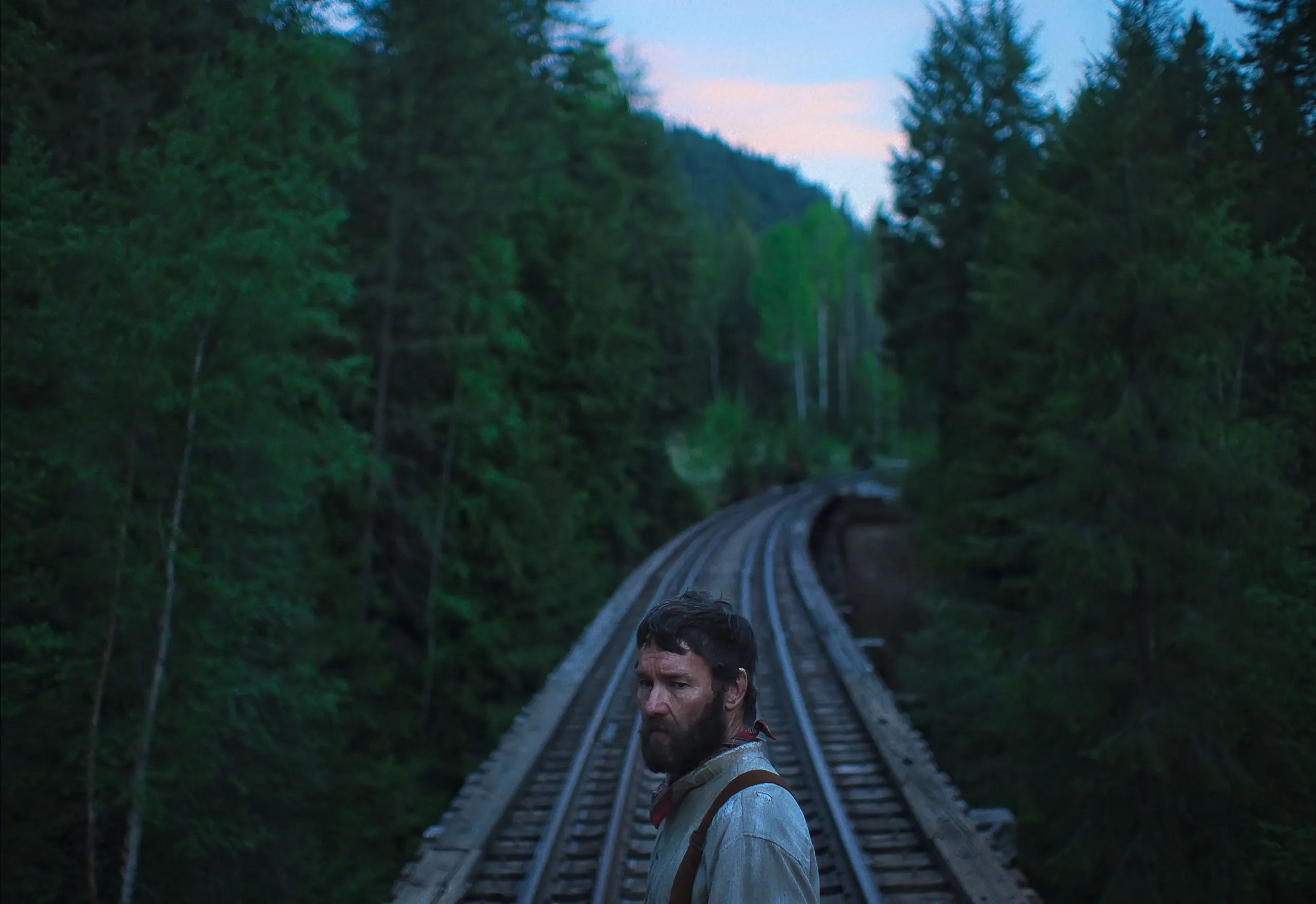
Based on Denis Johnson’s late career novella of the same name, Train Dreams chronicles the life of itinerant worker Robert Grainier (Joel Edgerton) as he meanders through the first half of the twentieth century. Orphaned and deposited in northern Idaho, the soft spoken and pensive Robert spends seasons on railroad crews and logging teams, etching American industry into the Northwest terrain. He loves, homesteads, and loses, wondering what are the threads that bind his life and where they lead. Immediately recalling the work of Terrence Malick, Train Dreams is no less existential or metaphysical, but instead of expanding outward, it burrows into a man’s life and his limited perspective. The narrow scope through which Robert sees the world is realized by cinematographer Adolpho Veloso’s square frame. With only a small window into Robert’s existence, every composition becomes meticulous, the camera often tilted to the sky to place people beneath the towering Douglas-firs. Zooms draw in and out, giving us a microscope slide instead of a panorama.
In one remarkable shot, almost resembling the morbid and darkly funny tableaus of Swedish auteur Roy Andersson, Veloso frames Robert and the breaking loggers in repose under the lush, jade green canopy. Men dot the space, which is shot in deep focus, paradoxically flattening the image into a painting. An evangelist lounges in the center, ministering to uninterested ears. The camera slightly draws back without cutting, placing a figure in the foreground. The caped stranger (Brandon Lindsay) politely announces that he is looking for Sam Loving from New Mexico and that he has a message for him. In the continuous and static shot: the preacher scrambles to his feet to escape, the stranger shoots him in the back and calmly walks along the composition’s Z-axis, deeper into the frame, before killing him execution style. “The man shot my brother,” the stranger, standing at the back of space, announces to the now interested men. “He killed him only because of the color of his skin.” Robert silently steps aside as the stranger bids the men adieu and walks out of the frame.
The episode is one of many in Train Dreams to which Robert bears witness, metonymic stand-ins that bind him to the sweeping narrative of American history in the early twentieth century. Earlier in the film, as Robert is working on the Spokane International Railway, he stands feckless, stunned, as a group of white men throw a Chinese laborer (Alfred Hsing) off a bridge. In Train Dreams, the arc of American arc history is embodied, personified, experienced by Robert and the audience in discrete parts, life events delimited and broken up by the square frame. We are not on Barthes’ balcony, watching history unfold in grand visual continuity; rather, we are with Robert, bearing witness to history’s isolated instances, asked to find the thread that links it all together.
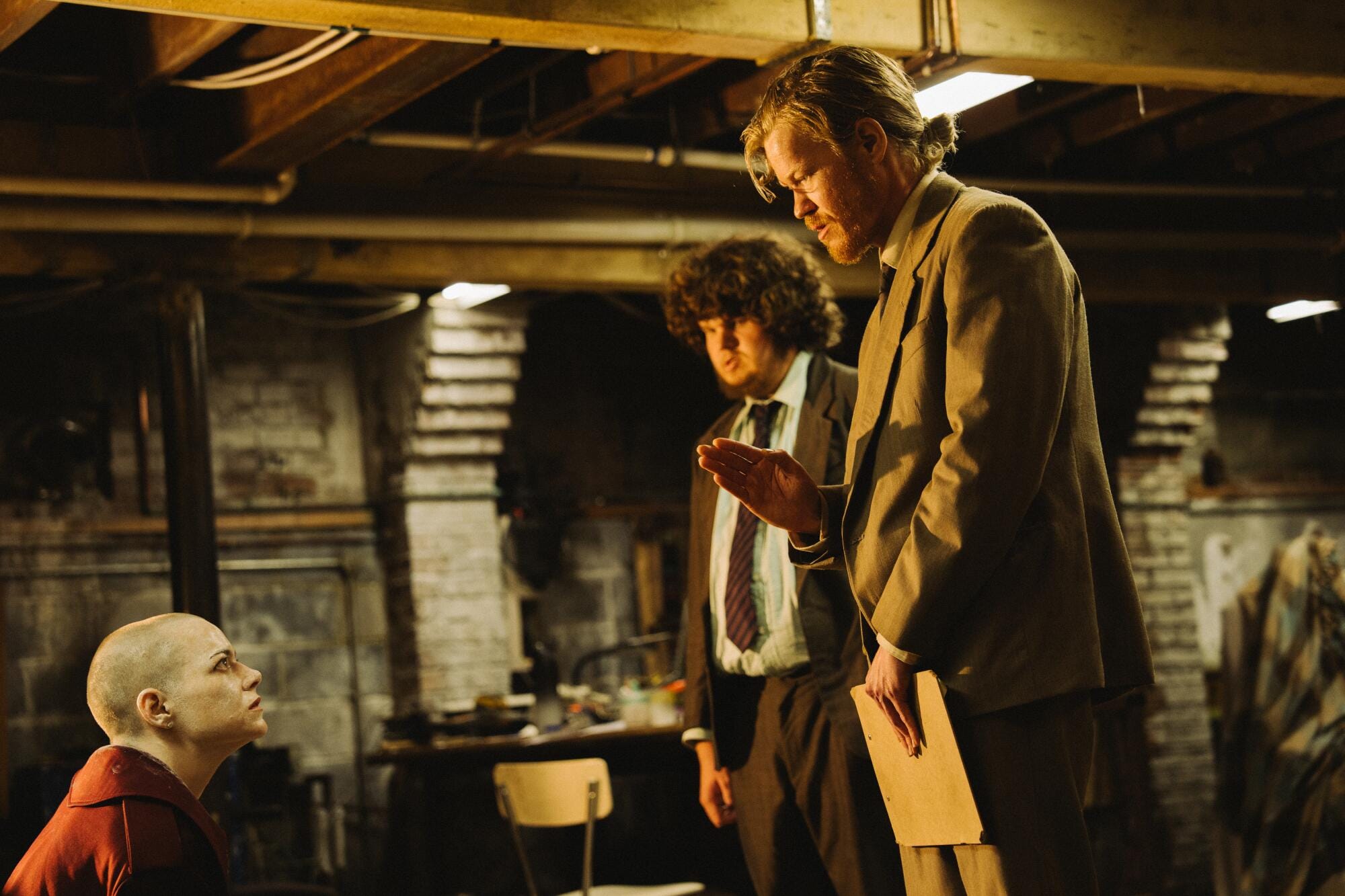
If in Train Dreams we see the square aspect ratio’s ability to hone embodied perspective, Yorgos Lanthimos’ 2025 paranoid black comedy, Bugonia, demonstrates its power to frame the human face. The film stars Jesse Plemons as Teddy who, with his neurodivergent cousin Don (Aidan Delbis), kidnaps Michelle Fuller (Emma Stone), a high-powered CEO of a pharmaceutical conglomerate, whom Teddy and Don believe is an alien intent on subjugatingordinating humanity. Reentering the overtly political waters of Poor Things (2023), Lanthimos’s previous collaboration with Stone, Bugonia swaps gender commentary for class warfare, as well as the already tight European widescreen (1.66:1) for the tighter still 3:2. Save for its absurdist dénouement, Bugonia’s key scenes occur in Teddy’s basement, where, in oscillating close-ups, Plemons and Stone play inquisitor and accused, underclass and elite. By far Lanthimos’ most actorly work, the scenes’ drama plays out in visages: Stone’s at once pleading and manipulative, Plemons’ sharklike and inscrutable, and each framed centrally by (steady Lanthimos hand) cinematographer Robbie Ryan.
The early film critic Béla Balázs remarked that cinema enabled for the first time the representation of “the appearance on the same face of contradictory features.” This “polyphonic” expression of features enabled “an adequate expression of the multiplicity of the human soul,” of which Balázs believed Dreyer’s Jeanne d’Arc was the supreme example. It feels wrong to compare Lanthimos and Dreyer, the trickster and the mystic, but one can’t help but see a perverse Jeanne d’Arc in Bugonia’s basement scenes: Plemons a composite of the judges, Delbis the sympathetic Jean Massieu, and Stone as Joan. Humiliated, shaven, eyes screwed upward at her captor, Stone effortlessly shifts, in a blink, from supplicating to malicious, despairing to threatening. Here, as in Jeanne d’Arc, the square frame is tailor made to represent the multiplicity of human expression, a call back to the silent cinema of portraiture and a repudiation of spectacle.
And then there’s Magellan (2025). Shot on the Panasonic Lumix GH7 – which the enterprising New York-based cinematographer could buy at B&H Photo for less than $1,800 – Lav Diaz’ anti-imperialist saga, shot by frequent Albert Serra DP Artur Tort, deploys a 1.33:1 frame to jarring metaphysical effect. In his compositions, Tort depicts an infiniteness that serves to complement the bottomlessness of his protagonist’s depravity. Spatially, the square frame extends boundlessly along the Z-axis, like putting a mirror in front of another mirror. The starkest of such images occur along the coasts of present-day Malaysia and the Philippines where, pointed along the shoreline, Tort’s linear perspective figures the mangled and mutilated dead of natives and conquistadors alike, dotting the sand and rocked by the sea’s eternal ebb and flow until the composition’s mystical vanishing point. Diaz and Tort seem to saturate the images with divine presence, but one that is always inaccessible to the plunderous missionaries who, in their most pitiful moments in the open Pacific, strain for providence. In Magellan, God is everywhere and nowhere and the searching gazes will never find Him.

Before his passing, eminent film theorist and historian David Bordwell found in Godard’s Contempt (1963) an interrogation of the CinemaScope aspect ratio. In the film, awkwardly framed rushes for Fritz Lang’s Odyssey adaptation testify to the ultra-widescreen’s difficulty framing humans. Today, the rush for more and subsequent proliferation of the widescreen has even trickled down to prestige TV. Shows like Severance and Pluribus are inexplicably shot in 2.35:1, the bloat of their productions mirrored in the dead space of their compositions: like the statues in Contempt’s movie within a movie, the human figures are often positioned uncomfortably at the center or edge of the frame, unbalancing the image without supporting any narrative themes. With most TV screens built to a 1.79:1 frame, a program shot in the classic TV ratio of 1.33:1 would still look disappointing, imposing big black bars on either side of the picture. Perhaps that’s why it was so exhilarating when the curtains drew in before Train Dreams – perfectly delimiting the world of the film.
The cinema is again in crisis, this time assaulted not only by the cultural hegemony of television and at-home streaming, but by industrial consolidation. It’s hard, then, to fault the return of theatrical spectacle and “premium formats”. We’ll take anything to get people back to the theater, after all. But must we accept this poptomist Faustian pact under whose regime the ghastly category of “Cinematic and Box Office Achievement” has infiltrated the once venerated halls of the Golden Globes and Academy Awards, which not only ghettoizes films that found mainstream success but marries profit margin to quality? The emergence, then, of visually diminutive films like Train Dreams, Bugonia, and Magellan is a shot in the arm not for the industry, but cinematic form itself.
Read the latest from Nerve
Unstoppable Forces, Immovable Objects: The Ping-Pong Table as Stage & Battlefield in Marty Supreme

An enthused Marty Mauser (Timotheé Chalamet) scans the crowd – gazing upon his "competition" at the 1952 British Open. Eager and hungry to show that he is the best: no contest. He is, however, stopped in his tracks by none other than Koto Endo (Koto Kawaguchi) and his fellow representatives for Japan. Marty cannot help but wonder about their presence. H…